Anagh Dave, Vivek V. Manepalli, Roshith Mittakolu, Clayton Pullins, Michael T. Barako, Samuel Graham, and Damena Agonafer
IEEE Transactions on Components, Packaging and Manufacturing Technology ·
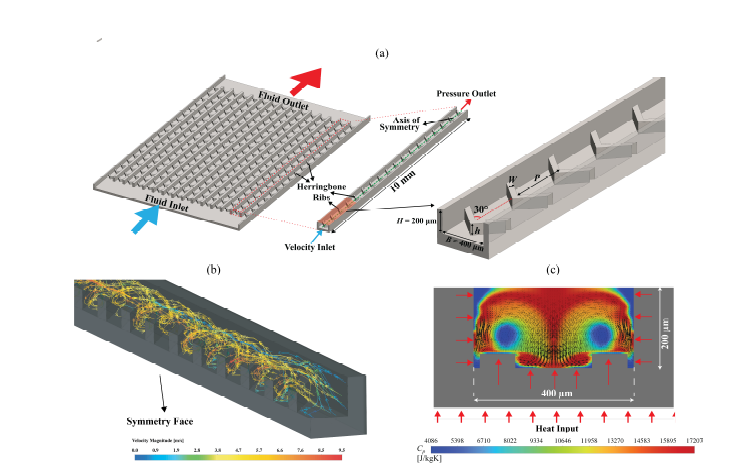
How can microchannel geometry help a microencapsulated phase-change material (MEPCM) slurry use more of its latent heat? This numerical study explores herringbone ribs that generate secondary vortices, improve transverse mixing, and promote particle melting. Regression-based heat-transfer and friction correlations support multi-objective optimization with NSGA-II, balancing cooling enhancement against pressure drop.
Geometry and simulated flow. (a) Channel array and herringbone-rib geometry; (b) flow trajectories through the ribbed channel; (c) cross-sectional enthalpy distribution and flow vectors with heat entering through the sidewalls and bottom. Numerical visualization, not experimental imaging.Open full-size figure ↗
02 / Selected work
Ideas, made tangible.
Interactive exploration and technical writing from my Cooling Lab.
COOLING LAB / INTERACTIVE
Interactive tool
Coolant Loop Simulator
A drag-and-drop sandbox for assembling cooling components and exploring how the model responds to flow, heat load, and coolant choices.
An illustrative learning tool, not a validated engineering solver.
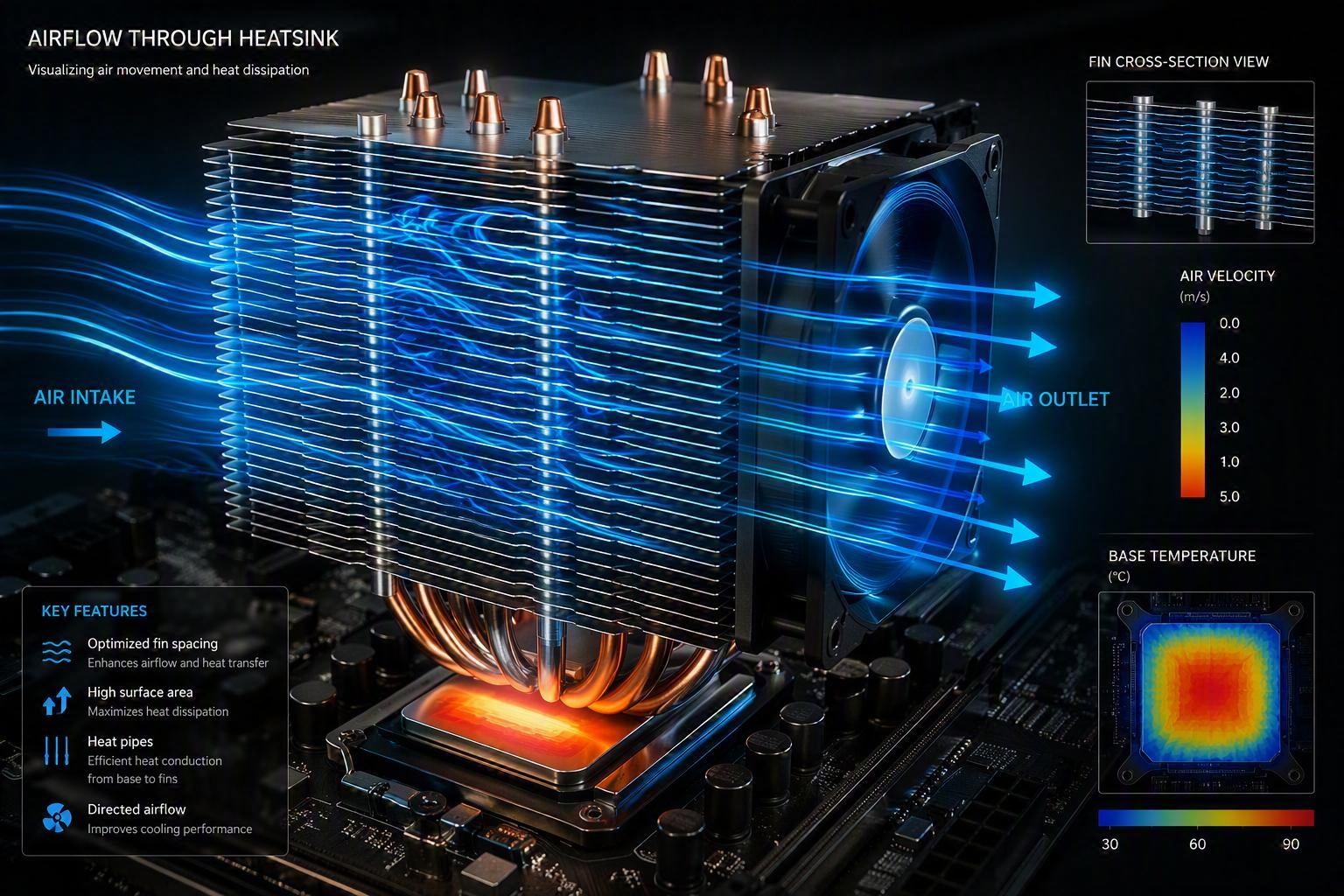
Two separate guides: heat sinks transfer heat to air; cold plates transfer heat to liquid coolant. Explore the design tradeoffs and interfaces behind each approach.